
Understanding Computer Security and Networking Concepts
What do you understand by the term computer security?
Computer security refers to the protection of computer systems, networks, and data from unauthorized access, theft, damage, or disruption. It encompasses various measures such as encryption, firewalls, antivirus software, access controls, and security policies to safeguard digital assets and ensure confidentiality, integrity, and availability.
Confidentiality:
Ensuring that sensitive information is accessible only to authorized individuals or entities.
Read MoreDirect Manipulation: Principles, Benefits, and Applications
Introduction
Direct manipulation extends the concept of direct manipulation in personal computers to complex environments. It involves the physical operation of a system or machine at a distance, such as in surgery, power plants, and military operations.
Principles of Direct Manipulation
- Continuous representations of objects and actions with meaningful visual metaphors.
- Physical actions or presses of labeled buttons, instead of complex syntax.
- Rapid, incremental, reversible actions whose effects on the
Java Code Snippets
1.-wix of te foyowing lines wiy compile witout warning or error.
5)
int i=10;
2.-wat wiy appen if you try to compile and run te foyowing code
public class myclass {
public static void main(string arguments[]) {
ametod(arguments);
}
public void ametod(string[] arguments) {
system.
Out.
println(arguments);
system.Out.Println(arguments[1]);
}
}
) error can’t make static reference to void ametod.
3.-wix of te foyowing wiy compile witout error
)import java.Awt.*;
package mypackage;
class myclass {}
4.-a byte can
OSPF: A Comprehensive Guide
For which IP networks is OSPF version 2 designed for?
The current version 2 (RFC 2328) is designed for IPv4.
What are the major advantages of OSPF compared to distance vector protocols?
The major advantages of OSPF as well as all link-state protocols are: fast convergence, scalability to larger networks, less susceptibility to bad routing info.
What are the main features of OSPF?
- Use of areas: reduce the impact on memory and CPU, contains the flow of routing protocol traffic, and make feasible the construction
Mobile Networking: Protocols, Architectures, and Mechanisms
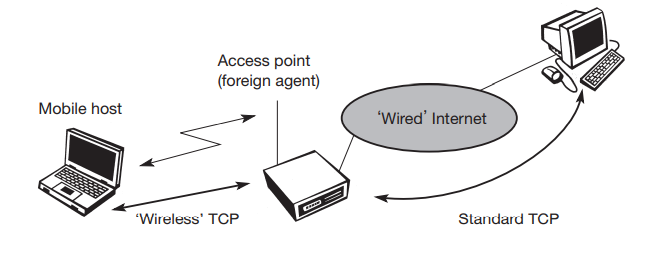
Indirect TCP (I-TCP)
Two competing insights:
TCP performs poorly together with wireless links;
TCP within the fixed network cannot be changed.
I-TCP segments a TCP connection into a fixed part and a wireless part.
-
I-TCP segments a TCP connection into a
fixed part – Standard TCP is used (between the fixed computer and the access point)
wireless part – optimized TCP protocol
splitting of the TCP connection at, e.g., the foreign agent into 2 TCP connections, no real end-to-end connection any longer
hosts
Information and Communication Technologies (ICT)
The technologies of information and communication technologies (ICT) are a set of technical developments and devices that integrate advanced functionality for storage, processing, and data transmission. They have revolutionized the relationship with their environment. The world as we knew it no longer exists, and our industry is no stranger to these changes. ICT allows us to integrate into virtual spaces all the activities necessary for everyday business. Never before in history has it been so easy
Read More