
Email Writing: Formal, Informal, and Useful Phrases
Email Writing: Formal and Informal Styles
Informal Email Example
Informal Email
Hey Laia,
Just a quick email to see how you are. Have you got any news? It’s been a bit crazy here this summer. There’s loads of things going on—Jen’s got a new boyfriend, and Mum and Dad don’t like him. They told her that she couldn’t go to Ibiza with him in August. She was really annoyed.
Also, I saw your Facebook status has changed—single?? Have you and Emma split up then, or what? I wasn’t expecting that!
Read MoreSpanish Civil War: Key Events and Political Developments (1936-1939)
The Spanish Civil War (1936-1939)
1936: The Genesis of Conflict
Key Events:
- Triumph of the Popular Front (Left Republicans): Increased political polarization.
- Manuel Azaña’s Presidency: Attempted to maintain stability within the Republic.
- July 17: Military Insurrection Begins: Sparked by deep social and ideological divisions.
- October 1: Franco’s Government Established: Marked a significant turning point in the war.
Popular Front Aims:
- Continued reforms.
- Strengthening education.
- Amnesty for political prisoners.
Key Concepts of the Industrial Revolution and Social Change
Technological Advancements
Spinning Jenny
Developed by James Hargreaves, the Spinning Jenny revolutionized textile production by enabling the spinning of eight threads simultaneously, significantly increasing efficiency.
Economic and Social Structures
Economic Liberalism
Championed by Adam Smith, this system promoted free markets and minimal government intervention in economic activities.
Law of Supply and Demand
This fundamental economic principle explains the relationship between the availability of
Read MoreArgentina’s National Autonomist Party (PAN) and Electoral Reform
Argentina’s National Autonomist Party (PAN)
Roca became president of the country, supported by a league formed by rulers of different provinces, which formed the National Autonomist Party (PAN). Within the PAN, all decisions were made by the president, governors, senators, and some politicians; they formed the so-called elite. This system allowed the PAN oligarchic control of the elections, remain in power, and prevent access to the government for his political opponents.
The presidents, governors,
Read MoreUnderstanding Punishment, Social Contracts, and Legal Obligations
Punishment
Punishment
Definition of Punishment
Punishment is the infliction of a penalty or sanction on an individual or group for a perceived wrongdoing, offense, or violation of rules, laws, or social norms. The primary purpose of punishment is to deter the individual or group from committing similar wrongdoings in the future, as well as to provide justice and reparation to the victims or society as a whole.
Types of Punishment
There are several types of punishment, including:
- Corporal Punishment: Physical
Marxist Economics: Key Concepts Explained
Marxist Economics: Key Concepts
Work is the activity by which humans transform reality to meet their physical and spiritual needs. In operating companies, work experience is often seen as alienated rather than a means of self-realization. For Marx, work becomes an anthropological category. He posits that humans possess an inherent drive to transform reality. Humans are an asset, and work is the expression of their mental capacities. Work can be an end in itself, sought and enjoyed for its own sake.
Read MoreParallel vs Serial Data Transmission: Types & Communication Channels
Parallel Transmission
Parallel: All bits are transmitted simultaneously, followed by a brief interval. This transmission rate is suitable for short distances, typically within a machine or between closely located machines. The primary advantage is speed, while the main disadvantage is cost.
Data multiplexing can also be considered a form of parallel transmission, where data is transmitted on a single line by interleaving different data streams.
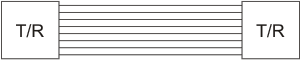
Parallel Transmission
Serial Transmission
In serial transmission,
Read MoreThomas Aquinas and Medieval Scholasticism: A Synthesis of Reason and Faith
Thomas Aquinas and Medieval Scholasticism
The Context of Scholasticism
The works of St. Thomas Aquinas showcase the relationship between cultural phenomena, philosophers, and theologians within medieval Christian scholasticism. This wasn’t the only scholasticism; Jewish and Arab scholasticism developed around the same time, or perhaps slightly earlier, with key figures like Ibn Gabirol and Maimonides in Jewish thought, and Avicenna and Averroes (the prominent commentator on Aristotle) in Arab thought.
Read MoreNitrates and Carbonates: Properties, Formation, and Environmental Impact
Nitrates: Properties and Formation
Nitrates: Nitrates are salts derived from nitric acid. They are formed by the junction of the nitrate anion (NO3–) with a metal. They are less abundant than carbonates and are characterized by their high solubility and a structure similar to carbonates. Nitrates are an essential part of fertilizers. Plants convert them back into organic nitrogen compounds such as amino acids.
Inorganic nitrates are formed in nature by the decomposition of nitrogenous compounds such
Read MoreNEP, Stalinism, New Deal & Social Changes: Analysis
NEP Application: Overcoming War Losses
The NEP (New Economic Policy) aimed to:
- Overcome the losses of the war.
- Achieve economic growth to reach socialism.
- Support the nation through peace and without external assistance.
NEP Features:
- Free trade is allowed, outside state control.
- Foreign companies and capital investments are permitted.
- Wages and salaries are performance-based.
- Small private companies (more than 20 workers) are adopted.
- The state controls banking, foreign trade, transport, and key industries.