
World War II: Global Conflict and Consequences
World War II
| World War II | ||||||||
|---|---|---|---|---|---|---|---|---|
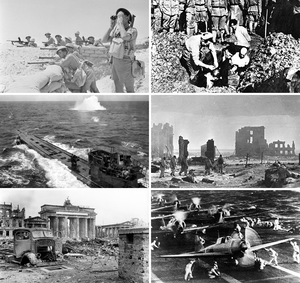 From left to right from top: Commonwealth troops in the desert to be buried alive, Chinese civilians by Japanese soldiers, a German submarine under attack, Soviet forces in a winter campaign, Soviet troops in Berlin, Japanese aircraft about to take off an aircraft carrier. | ||||||||
|
Spanish Civil War: From Coup to Totalitarian State
1) The Outbreak of the Civil War
From Coup to Civil War
The military uprising began in the Spanish possessions in North Africa (Melilla) on July 17, 1936. Colonel Yagüe, head of the legion, took up arms against the Republic. The next day, it extended to the Peninsula, and Franco, who had already secured the triumph of the insurrection in the Canary Islands, went to the Peninsula leading the Army of Africa. Its proponents justified the need for action to end a government they considered illegitimate
Read MoreSpain’s Restoration: Monarchy, Politics, and Power (1874-1931)
The Restoration (1874-1931)
Cánovas’s Political System
Cánovas’s plan to establish the monarchy above political parties relied on a new constitution. Congress, divided between Catholic unity and tolerance, created a confessional state allowing private practice of other religions. The 1876 Constitution granted the king power to appoint the head of government and suspend individual rights, establishing a bicameral parliament. This constitution, in effect until 1931, was undermined by turnismo.
Turnismo
Read MoreFranco’s Spain: Dictatorship to Democracy (1939-1975)
Franco’s Political System (1939-1975)
Francisco Franco’s regime was a dictatorship characterized by opposition to communism and liberal democracy, and the defense of traditionalism in Spain.
Social Groups Supporting Franco
Franco’s victory in the Civil War benefited groups fearing loss of privileges:
- The wealthy bourgeoisie, army, and Catholic Church supported a regime guaranteeing their power.
- Landowners, banking, and business sectors regained economic dominance.
- The army held numerous political and
Interwar Period & World War II: 1918-1945
1. The Interwar Period: 1918-1939
The years between the end of World War I (1918) and the start of World War II (1939) are known as the interwar period.
The 1920s were generally optimistic, marked by innovation and growth, with the US leading global finance. However, the 1929 New York Stock Exchange crash triggered a worldwide financial crisis, leading to unemployment and poverty. This crisis revealed the limitations of the liberal economic system.
The US pursued radical reforms under President Franklin
20th Century Conflicts and Transformations
Spanish Second Republic Reforms
The Spanish Second Republic initiated agrarian reforms, impacting landowners and wages. Military reforms faced opposition, leading to the closure of reform schools and clashes with the Church hierarchy. The 1933 election saw the conservative CEDA suspend reforms, resulting in strikes and the 1934 Asturias Revolution, repressed by the army. The 1936 election restored the Popular Front, leading to Catalan autonomy (GA 1936-1939). Conservative factions opposed the government,
Read More