
Understanding the Linguistic Sign: Key Features & Components
The Linguistic Sign: An Inseparable Unit
The linguistic sign is an inseparable unit with two levels:
- Signifier (Expression): Identifiable with the acoustic image.
- Signified (Content): Identified with the concept.
It is further characterized by the following features:
Key Features of the Linguistic Sign
- Arbitrariness: The relationship between signifier and signified is unmotivated, a product of human will.
- Conventionality: Language users accept the signs, whose values have been agreed upon throughout their
Understanding Tree and Linked List Data Structures
A tree is a nonlinear hierarchical data structure comprising a collection of entities known as nodes. It connects each node in the tree data structure using edges, both directed and undirected.
General Tree
The general tree is a type of tree where there are no constraints on the hierarchical structure.
Tree Traversal
Traversal of the tree in data structures is a process of visiting each node and printing its value. There are three ways to traverse a tree data structure.
Binary Search Tree
A binary search
Read MoreLanguage Evolution: A History of Change
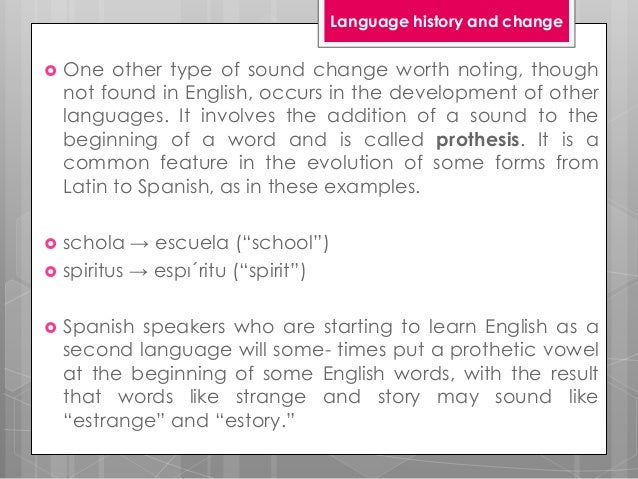
Sound Change: Prothesis
One other type of sound change worth noting, though not found in English, occurs in the development of other languages. It involves the addition of a sound to the beginning of a word and is called prothesis. It is a common feature in the evolution of some forms from Latin to Spanish, as in these examples:
- schola → escuela (“school”)
- spiritus → espı́ritu (“spirit”)
Spanish speakers learning English as a second language sometimes use a prothetic vowel, making words like strange
Advantages of Plastic Money, Shopping Centers, and Healthy Habits
Advantages of Plastic Money
The use of plastic money has increased significantly lately due to three main advantages.
Ease of Use
First, cardholders do not need any special knowledge, as using debit cards is very easy. They can withdraw money from a cash machine just by keying in a password whenever they want. For instance, some people take out some cash from ATMs before going shopping.
Safety
Second, cardholders do not need to carry cash all the time, so using debit cards can be safer. As a result,
Read MoreRadiographic Film: Composition, Latent Image, and Characteristics
Radiographic Film: Structure and Function
Radiographic film captures the remnant radiation, allowing visualization of the patient’s internal structures. It consists of several key components:
Base
Provides support, resistance, and a rigid structure. It is typically transparent, with a bluish tint, and made of polyester.
Emulsion
A composite of silver halide crystals suspended in gelatin. This porous material acts as a physical support for the silver halide crystals. The crystals have a lattice-like structure,
Read MoreOctober Revolution of 1934: Causes, Consequences, and Aftermath
The October Revolution of 1934
The entry of three CEDA ministers into the government in October 1934 was interpreted by the Socialists as a surrender of the Republic to its enemies. This event triggered a revolution that had been long in preparation. The insurrectionary movement had the support of the Generalitat, the PCE, and the CNT, but it largely became a political general strike in the major cities. In some instances, the conflict lasted a week, with attempts at armed insurrection by the socialist
Read MoreMale and Female Reproductive Systems: Anatomy
Male and Female Reproductive Systems
Spermatogenesis is responsible for producing sex cells called gametes. It reaches its maximum development at puberty, which occurs at different ages in boys and girls. Sexual dimorphism is different in both sexes. It is also responsible, along with the hormones, for producing the appearance of secondary sexual characteristics, such as the appearance of pubic hair, etc.
Male Reproductive System
The male reproductive system includes:
- Internal genital organs: These
Symbolism in Miguel Hernandez’s Poetry: An Analysis
Images and Symbols in the Poetry of Miguel Hernandez
Throughout the work of Miguel Hernandez, the consistent use of various symbols reflects his poetic world.
Symbolism in “Expert in Lunas”
In his early work, Expert in Lunas, symbolism plays a crucial role, reflecting the author’s moods and feelings. He establishes cross-media metaphors using elements such as palms, watermelons, and treadmills. However, the moon is the most significant element, taking on different meanings throughout his work.
In Expert
Read MoreSpanish Crown Succession: Rules and Regency
Article 57.1 of the Spanish Constitution (CE) states that the Crown of Spain is inherited by the successors of HM Juan Carlos I de Borbón, the legitimate heir of the historic dynasty. Upon the death of the King, the heir automatically assumes the Crown, regardless of age. The CE addresses the scenarios of a minor King (Article 59) and a disabled King (due to illness, age, etc.). In such cases, the King retains the title, but a Regent performs their functions.
Succession Event
The succession event
Read MoreSecond Vatican Council: Key Texts and Impact
The Second Vatican Council (1962-65)
The Second Vatican Council, informally known as Vatican II, addressed relations between the Roman Catholic Church and the modern world. It was the twenty-first ecumenical council of the Catholic Church and the second to be held at Saint Peter’s Basilica in the Vatican. The council formally opened under the pontificate of Pope John XXIII on 11 October 1962 and closed under Pope Paul VI on the Feast of the Immaculate Conception in 1965.
Several changes resulted from
Read More