Molecular Biology and Genetics Fundamentals
Cellular Genetics and DNA Structure
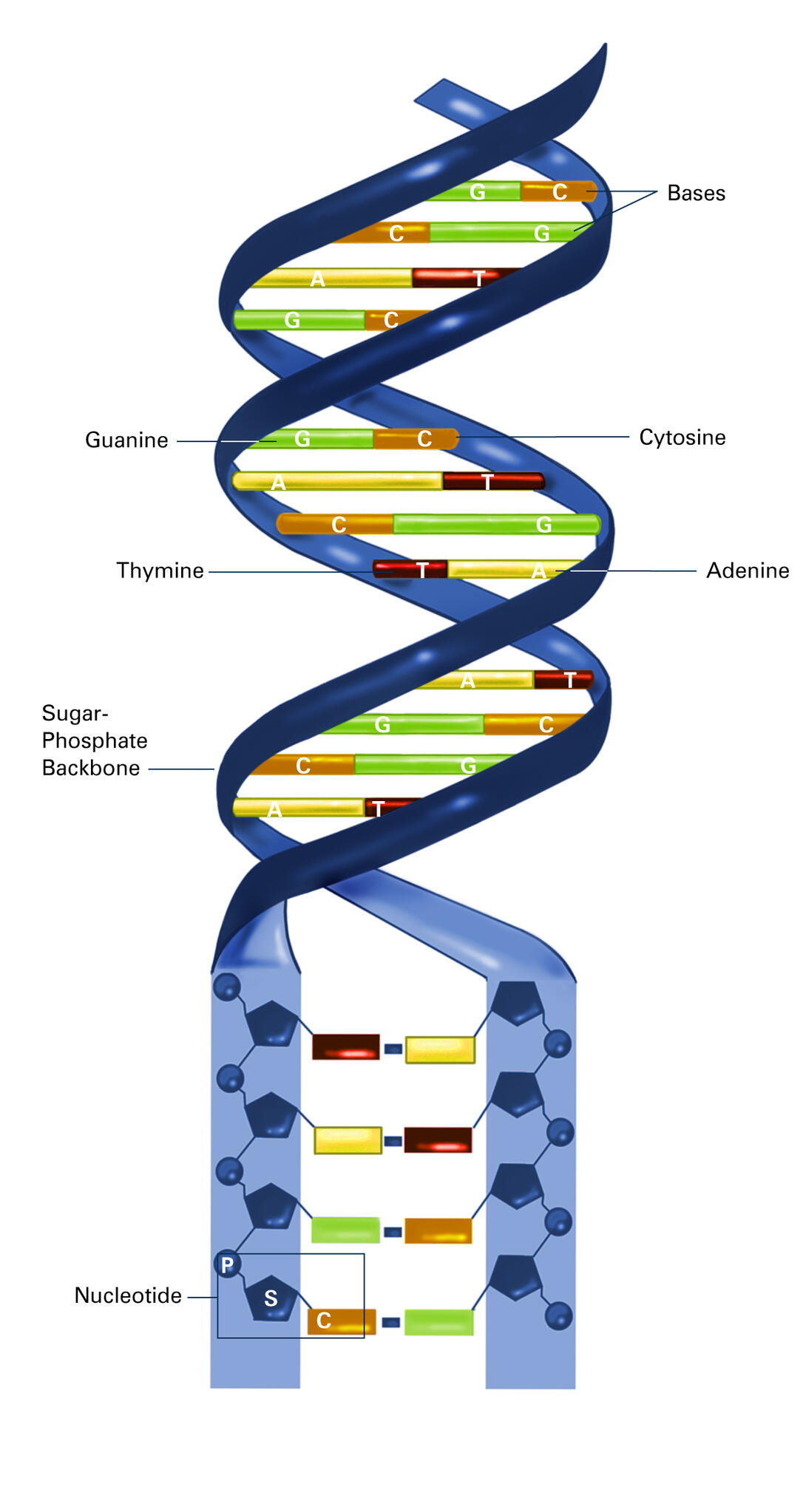
Each cell of the body contains 23 pairs of chromosomes—46 in total—with 23 inherited from the mother and 23 from the father. Each chromosome contains genes, which consist of portions of DNA (Deoxyribonucleic acid). DNA is made up of nucleotides, which are the building blocks of both DNA and RNA. Nucleotides contain nitrogenous bases, and the sequence of these bases determines the differences in traits.
DNA exists as a double helix formed by two antiparallel strands of repeating nucleotide units. Each nucleotide consists of a phosphate group, a deoxyribose sugar, and one of four nitrogenous bases: Adenine (A), Guanine (G), Cytosine (C), or Thymine (T). The sugar and phosphate groups form the backbones of the ladder, while the base pairs—A always pairing with T, and C with G—form the rungs. These base pairs are held together by weak hydrogen bonds, which allow the DNA to “unzip” during processes like replication. DNA has two strands (5′ to 3′ and 3′ to 5′) that are antiparallel, meaning they run in opposite directions.
Mitosis and Meiosis Processes
Mitosis is the process of making new cells for your body. During mitosis, your genes instruct your cells to split into two by making a copy of your chromosomes. It consists of prophase, prometaphase, metaphase, anaphase, and telophase, resulting in two identical diploid daughter cells.
Meiosis is the process of making egg and sperm cells for the next generation. It is a two-part process (Meiosis I and Meiosis II) that involves prophase, metaphase, anaphase, and telophase stages occurring twice, producing four genetically different haploid cells.
- Meiosis I: Separates homologous chromosomes, creating two haploid cells.
- Meiosis II: Separates sister chromatids in these cells, resulting in four genetically distinct haploid cells.
Population Genetics and Evolution
The Hardy-Weinberg equilibrium is a principle in population genetics stating that a population’s allele and genotype frequencies will remain constant over generations—meaning the population will not be evolving—if certain ideal conditions are met.
Mechanisms of Genetic Change
- Bottlenecks: These reduce a generation’s population size significantly, even if the event is short-lived.
- Migration: The movement of individuals from one place to another. Genes become incorporated into the new gene pool, leading to gene flow, provided the newcomers breed and survive to reproduce.
- Relative Fitness: This measures the reproductive success of an individual or genotype compared to others in the population.
- Genetic Drift: A mechanism of evolution in which allele frequencies of a population change over generations by chance.
- Additive Alleles: Versions of genes where each allele independently contributes to a trait’s intensity, resulting in a continuous range of phenotypes.
- Gene Duplication: Leads to more variety in genes, allowing for more mutations and variation.
Phylogenetics
A phylogenetic tree is a branching diagram, or “tree of life,” that illustrates the evolutionary relationships and shared ancestry among different species, organisms, or genes. To construct one, researchers gather sequence data (DNA or protein), align the sequences to identify homologous positions, and use computational methods to infer evolutionary relationships.
DNA Replication Stages
DNA replication ensures that genetic information is passed on accurately during cell division.
1. Initiation
The process starts at the origin of replication. Enzymes like DNA helicase break hydrogen bonds to unwind the double helix, causing Y-shaped structures to form. Certain proteins attach to the separated strands to prevent them from rejoining.
2. Elongation
An enzyme called primase creates sequences on the template strands to serve as a starting point for DNA polymerase. DNA polymerase binds to the RNA primer and adds nucleotides in a 5’ to 3’ direction. The leading strand is synthesized continuously, while the lagging strand is synthesized in short intervals. Another DNA polymerase removes the RNA primer, and special enzymes join the lagging strands together.
3. Termination
Replication ends when two replication forks moving in opposite directions meet, resulting in two identical DNA molecules.
Genomic Structures and DNA Damage
- Plasmids: Small, circular DNA molecules that exist separately from a cell’s chromosome and replicate independently.
- Euchromatin: Less condensed DNA found in gene-rich genomic loci.
- Heterochromatin: Densely packed DNA found in many inactive parts of the genome.
DNA Damage: This can be caused by UV radiation, chemicals, and ionizing radiation. Metabolic processes can also generate reactive oxygen species (ROS), leading to oxidative damage. Additionally, errors can occur naturally during DNA replication.
The Central Dogma: Transcription and Translation
The Central Dogma of Molecular Biology states that genetic information flows from DNA to RNA and then to proteins through three stages: Replication, Transcription (DNA to mRNA), and Translation (mRNA to protein).
Transcription
Transcription involves Initiation (enzyme binds to the promoter), Elongation (synthesis of a complementary RNA molecule), and Termination (release of the RNA transcript). This process is regulated by Cis-regulatory elements (on the same chromosome) and Trans-regulatory elements (located elsewhere).
Translation and Ribosomes
A codon is a sequence of three nucleotides that codes for a specific amino acid. Ribosomes act as the protein synthesis factory, reading mRNA codons to link amino acids into polypeptide chains.
- Initiation: Ribosomes and tRNA attach to the mRNA.
- Elongation: Amino acids are added to the growing chain via peptide bonds.
- Termination: A stop codon triggers the release of the completed protein.
Biotechnology and Genetic Engineering
Polymerase Chain Reaction (PCR)
- Denaturation: DNA is heated to 95°C to separate the strands.
- Annealing: Temperature is lowered to allow primers to bind.
- Extension: DNA polymerase adds nucleotides to create new strands.
DNA Sequencing
Sanger sequencing uses chain-terminating dideoxynucleotides to determine nucleotide sequences. Modern methods include Illumina (highly accurate, short reads) and Nanopore (long reads via electrical signals through a pore).
Molecular Cloning and Gene Modification
Molecular cloning involves fusing a DNA fragment with a vector to create recombinant DNA. Other techniques include:
- Knockout: Completely removes or alters a gene’s DNA.
- Knockdown: Reduces a gene’s expression levels.
- Complementation: Restores a gene’s function to study mutations.