
Evolution and Classification of Life
Terms
Phylogeny: Evolutionary history and relationships (e.g., domains)
Phylogenetic Tree/Cladogram: Diagram reconstructing history based on morphology/physical behavior
Heterotrophic: Consumers (cannot produce their own food)
Autotrophic: Producers (can produce their own food – e.g., photosynthesis in plants)
Cephalization: Cluster/concentration of sensory organs (e.g., brain, nerves)
Carl Linnaeus
Binomial nomenclature: Uses genus and species names to name the organism (e.g., Homo sapiens, Escherichia coli)
Taxonomy
Classifies organisms according to the presence/absence of shared characteristics
Kingdom – Phylum – Class – Order – Family – Genus – Species
e.g., King Phillip Came Over For Grape Soda
Kingdom: Domain Eukarya
Protista: Widest variety, unicellular, heterotrophic and autotrophic, motility (pseudopodia, cilia, flagella), disease-associated (dysentery, malaria)
e.g., seaweed, slime molds
Plantae: Multicellular, autotrophic (photosynthesis)
e.g., flowering plants, ferns, mosses, algae
Fungi: Heterotrophic, decomposers, cell wall contains chitin, secrete hydrolytic enzymes (extracellular digestion)
e.g., mold, yeast, mushrooms
Animalia: Multicellular, heterotrophic, sexual reproduction (diploid stage – two sets of chromosomes), monophyletic (traced back to a common ancestor)
Multi-branched Phylum: Porifera, Cnidaria, Platyhelminthes, Nematoda, Annelida, Mollusca, Arthropoda, Echinodermata, Chordata
Classified by anatomical features (common structures → DNA data, embryonic development)
Primitive: No symmetry, no cephalization, two cell layers (endo, ecto), no true tissues, life in water, sessile
Complex: Bilateral symmetry, cephalization, three cell layers (endo, meso, ecto), tissues and organs, life on land, motile
Domain: Derived from Common Ancestors
Bacteria: Unicellular, prokaryotes, peptidoglycan, facultative anaerobes, decomposers, binary fission, conjugation and transformation, pathogens (disease-causing)
Archaea: Unicellular, prokaryotes, no peptidoglycan
Methanogens: Obtain energy by producing methane from hydrogen
Halophiles: Thrive in [high] salt conditions
Thermophiles: Thrive in high temperatures (e.g., hot springs)
Eukarya: Eukaryotes, no peptidoglycan
Bacteria | Archaea | Eukarya |
no nucleus | no nucleus | nucleus |
no organelles | no organelles | organelles |
no introns | introns (some) | introns |
Cells: Basic unit of life (e.g., neuron)
Tissues: Group of similar cells performing a particular function (e.g., muscle tissue)
Organs: Group of tissues performing related functions together (e.g., heart)
Gastrulation
Germ layers formed during embryonic development
Ectoderm: Outermost layer (e.g., skin and nervous system)
Endoderm: Innermost layer (e.g., viscera or guts)
Mesoderm: Middle layer (e.g., blood and bones)
Symmetry: Bilateral (symmetrical halves) and radial (symmetry around a central axis)
Fossil Records
Reveals the existence of species (extinction and evolution)
Radiometric Dating: Measure the absolute age of fossils based on the natural decay of the radioisotopes
Half-life: Time it takes to decay to half its products (e.g., Carbon-14 = 5730 yrs.)
Law of Superposition: Determine a fossil’s relative age (lower layer of rock = older)
Carbon Dating: Measuring the ratio of carbon in fossils (when organisms die they stop accumulating carbon)
Carbon-14 decays into N-14 which causes a shift in the carbon ratio after death
Comparative Anatomy
Homologous Structure: Traits with similar structure with a different function (common ancestry)
e.g., human hands, cat paws, whale fins, bat wings
Analogous Structure: Similar functions but different structures (suggests adaptation)
e.g., insect, bird, and bat wings
Vestigial Structure: Evidence of evolved structures
e.g., the appendix of humans evolved from being needed to becoming useless
Comparative Biochemistry/Molecular Biology
Common ancestors have similar biochemical pathways (e.g., humans and bacteria with glycolysis)
Cytochrome c: Present in all aerobic organisms
Comparative Embryology
Closely related organisms have similar stages of embryonic development
e.g., vertebrates begin with gill pouches on their throats – gills for fish and Eustachian tubes in mammal ears
Biogeography: Study of geographic distribution (current forms arose from ancestral forms)
e.g., Marsupials in Australia, Pangaea
Lamarck
Inheritance of acquired characteristics/“use and disuse”
Choose to change in response to the environment
e.g., giraffes get their long necks from stretching their necks for food in high trees
Darwin
Theory of natural selection/descent with modification (mechanism for how the population evolved)
Natural Selection: Organism doesn’t evolve, the frequency of an allele being passed on within a population changes
Populations grow (overpopulate) and result in competition, variations inherited make an unequal ability to survive (some more favorable than others)
“Survival of the fittest”: Best-fit individuals pass on their favorable traits (accumulate to become dominant) and continue to reproduce more offspring
Selection
Stabilizing (purifying): Eliminates “extremes” of a population, favors more common intermediate form
e.g., humans – majority birth weights around 6-8 lbs (greater mortality in smaller and larger infants)
Diversifying/Disruptive: Increases the extremes (more successful) at the expense of an intermediate
Arise of new species
Balanced Polymorphism: Two or more phenotypic variations in a single population of a species (each has an advantage and adapts)
e.g., variety of snail shell colors
Directional: One favored phenotype replaces another in a gene pool (rapid shifts in allele frequencies)
e.g., antibiotic resistance in bacteria, peppered moths
Sexual Selection: Based on variation in secondary sexual characteristics (competing and attracting mates)
e.g., antlers, horns, strength, canines, large stature
Sexual Dimorphism: The difference in appearance between males and females
e.g., Peacocks – females blend into the environment to protect their young, while males are bright-colored and flashy to attract the females
Artificial Selection/breeding: Favorable traits are selected by humans
e.g., dogs, racehorses (speed), hens (production)
e.g., cabbage, Brussel sprouts, kale, cauliflower were bred from a wild mustard plant (with different traits selected)
Variation
Geographic Variation (“Clines”): Two different variations of a single species adapt to different environments
e.g., white rabbit in the north, grey/brown rabbits in the south
Sexual Reproduction: Recombination of alleles during meiosis and fertilization
Independent Assortment, crossing over, random fertilization
Outbreeding: Mating within one species that is distantly related (opposite of inbreeding)
e.g., dominant male lions mate with young maturing lions from another pride, humans
Diploidy: 2n condition maintains and hides a huge pool of alleles that may be harmful/unfavored but advantageous in changing conditions
Heterozygotic Organism: Preserves multiple alleles to increase reproduction success and advantageous genotypes
e.g., sickle cell anemia:
Ss (heterozygous) – does not have sickle cell (mild), resistant to malaria
SS – does not have sickle cell, susceptible to malaria
ss – has sickle cell
Frequency-Dependent Selection (minority advantage): Decreases the frequency of more common phenotypes
e.g., predators develop “search images” that allow them to hunt particular prey
If the prey types differ, the more common type will be preyed upon (will continue when the less common become more common)
Evolutionary Neutral Traits: Traits have no selective advantages
e.g., different human blood types
Population Evolution
Genetic Drift: Change/fluctuation in allele frequency due to chance
Bottleneck effect: Natural disasters reduce the size of a population randomly (certain alleles may be under or overrepresented after)
Founder Effect: Small population breaks away from the larger ones to colonize a new area
e.g., Amish settlers, Polydactyly
Gene Flow: Movement of alleles in or out of a population, migration of fertile individuals
e.g., pollen, chimpanzees
Mutations: Changes genetic material (raw material)
e.g., a single mutation can introduce new alleles into a population
Nonrandom Mating: Individuals choose mates for specific reasons/traits (eliminates unfit traits)
Speciation
Two populations evolve and take several forms that they can no longer interbreed
Allopatric: A physical barrier prevents the species from breeding that they evolve on their own in different conditions (geographical isolation)
Sympatric: No geographical isolation
Polyploid: Cell has more than two paired (homologous) sets of chromosomes.
Occurs during nondisjunction
Habitat Isolation: Two organisms in the same area do not interact
e.g., different snake species/same genus live in the same area but one lives on land and the other closer to water
Behavioral Isolation (mating behavior): Leads to reproduction
e.g., fireflies send out blinking patterns to attract females, if it is reciprocated then breeding will occur
Temporal Isolation: Depends on the time of year
e.g., white rabbits mate from November-April, brown rabbits mate from May-October
Reproductive Isolation: Difference that prevents reproduction
Prezygotic barriers: Can’t happen before mating
e.g., a small male cannot mate with a large female due to size difference
Postzygotic barriers: Prevents the production of fertile offspring after mating (the produced zygote is sterile)
Evolution Patterns: Evolve into New Species from Speciation

Divergent Evolution: A population becomes isolated from the rest and is exposed to new selective pressures
e.g., Allopatric and Sympatric Speciation
Convergent Evolution: Unrelated species occupy the same environment and similar pressures (unrelated species exhibiting similar characteristics)
e.g., fins of a shark and whale (analogous structures form)
Parallel Evolution: Two species have similar evolutionary adaptations after divergence (similar environments and pressures)
e.g., marsupial and placental mammals
Co-evolution (“evolutionary arms race”): Reciprocal adaptations made from two sets of species
e.g., predator-prey relationships (one adapts forcing the other one to adapt as well to increase survival)
Adaptive Radiation: Newly emerged species from a common ancestor introduced to a new environment fill an ecological niche
e.g., Darwin’s 14 Galapagos finches
Gradualism: The theory that organisms descend from common ancestors gradually
Big changes happen by accumulating many smaller ones (fossil records refute – missing link)
Punctuated Equilibrium – new species evolve after a long period of stasis
large changes occur rapidly at different times over time
allopatric model supported → new species arises in a different place and expand their range and outcompeting abilities to replace ancestral species (develop better traits)
Evo-devo → study how gene sequences can regulate others and change forms and functions of organisms (why we can share DNA w/ common ancestors)
Gene Regulation → similar DNA in particular structures but genes are up/down-regulated to create different outcomes
Homeotic Genes: regulatory genes that control spatial organization of body parts
Hox genes – provide positional information for developing embryos
Heterochrony – evolutionary change in the rate of developing body parts
e.g. chimps and humans – genome signals to stop skull development before we develop powerful teeth/jaws like chimps
Origin of Life: early earth lacked free oxygen
Oparin and Haldane: organic molecules arose and developed w/out free oxygen
Sidney Fox: started w/ organic molecules and produced membrane-bound cell-like structures (proteinoid microspheres)
Miller and Urey Experiment → modeled early earth conditions by using atmospheric gases and a spark to simulate lighting and UV lights (tested Oparin-Haldane hypothesis)
proved energy could have converted the atmospheric molecules into organic molecules (amino acids)
Endosymbiotic Theory → the first cells on earth were anaerobic, heterotrophic prokaryotes that absorbed organic molecules from “primordial soup” (life in water) as a nutrient source
Eukaryotes arose when free living mitochondria and chloroplasts were enveloped by larger prokaryotes (beneficial symbiotic relationships became permanent)
Evidence: mitochondria and chloroplasts have their own DNA, the DNA is closely similar to prokaryotic DNA (wrapped in histones), organelles have double membranes (prokaryotic cell membrane, enveloped host cell membrane)
RNA World Hypothesis → the first genetic substance was not DNA (complex) but RNA (simple)
Ribozyme – catalyze reactions, transmits information generationally, removes its own introns/self-splices, joins amino acids to form polypeptides
Panspermia → life originated from microorganisms in outer space that initiate life on reaching a suitable environment
explains how life arose on earth but not how life arose itself
Hardy-Weinberg Equilibrium: stable, non-evolving populations (allelic frequencies do not change)
large population (no genetic drift), isolated population (no migration), no mutations, random mating, no natural selection
Calculations → the frequency of alleles within a population (p = dominant, q = recessive)
p + q = 1 p2 + 2pq (heterozygous) + q2 = 1
Ex. If 9% of the population has blue eyes, % of the population is heterozygous and homozygous for brown?
If 9% is blue (recessive) →√q2 = √0.09 = 0.3
p + q = 1 → p + 0.3 = 1 → p = 0.7
Heterozygous brown → 2pq → 2(0.7)(0.3) = 0.42 (42%)
Homozygous brown → p2 = 0.72 = 0.49 (49%)
Determining if a population is in Hardy-Weinberg Equilibrium –
Ex. Straight hair is dominant (IsIs), curly hair is recessive (IcIc), wavy hair is heterozygous (IsIc), a population of 1,000 individuals, 245 have straight, 393 had curly, and 362 had wavy
Allelic Frequencies:

If there are 1,000 individuals then you divide the total by 2,000 since every individual contains 2 alleles per phenotype
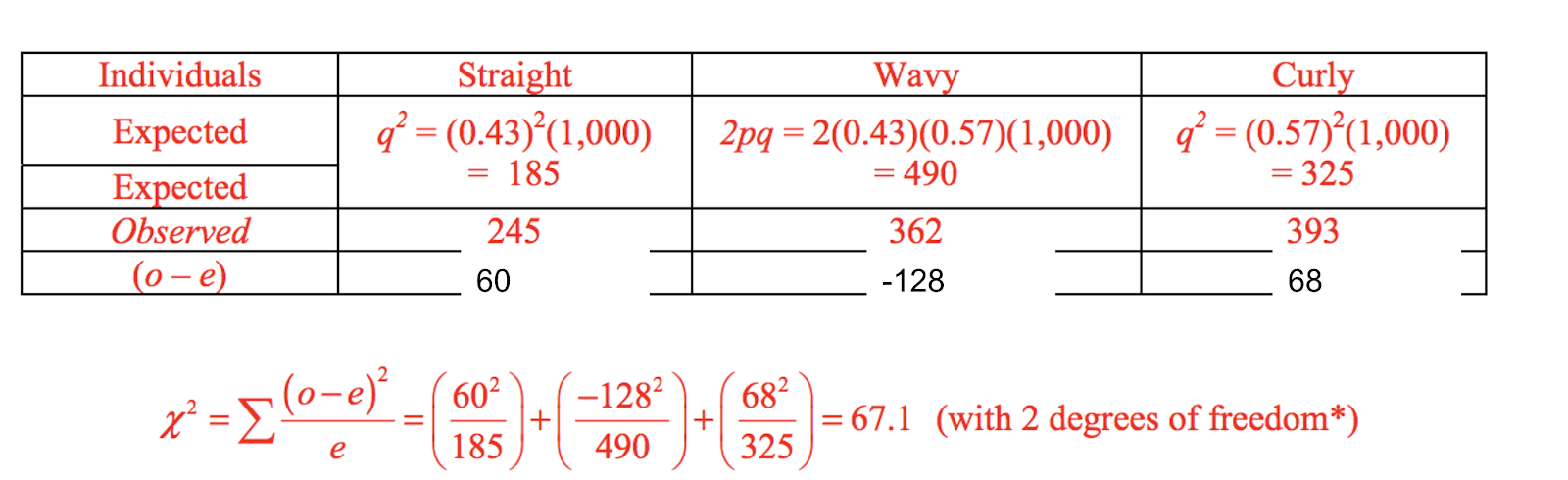
Degrees of freedom = n -1 (“n” being the total number of genotype classes)
The Null Hypothesis (H0) → interpret the chi-square value by considering the degrees of freedom and focusing on the probability of chance
hypothesis is rejected (does not follow the chi-square value) = population is not in Hardy-Weinberg Equilibrium (evolution occurring)